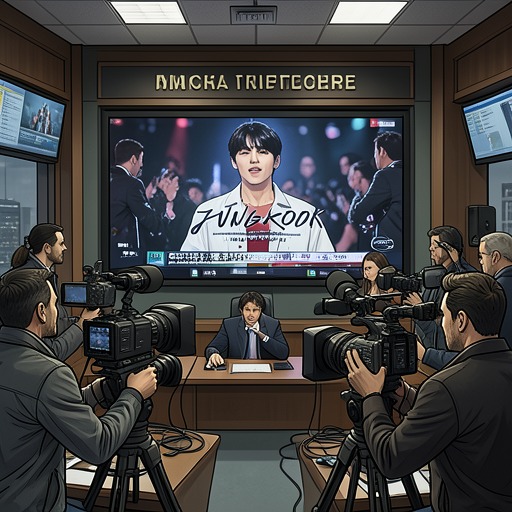
Daijingu Square
O fenômeno Jungkook: O sucesso do BTS e a criação de um superstar mundialTimes Square is the decisive public setting for the culmination of Jungkook’s first solo promotional campaign. In the narrative, its illuminated commercial center transforms a carefully prepared pop appearance into a test of whether Jungkook can command an audience beyond the established BTS and ARMY communities. The resulting performance makes the location a symbolic threshold between the aspiring idol of earlier years and the internationally recognized solo artist he has become.
Setting and Promotional Context
Times Square appears during the final phase of the campaign for Golden, after Jungkook had already performed on Good Morning America and The Tonight Show, collaborated with Usher, and presented shows in London beside the River Thames. On the day before the performance, he visited a Barnes & Noble bookstore in New York, carrying an iced coffee and staring with genuine astonishment at a display devoted to Golden. The next afternoon, after roughly twelve hours of sleep and a burrito bowl in his hotel room, he prepared for the performance with the awareness that the location would expose him to people who were not ARMY. That broader audience increased the pressure to deliver his best possible show.
The stage was positioned behind a digital billboard in the middle of Times Square. Its placement mattered: the performance would take place above one of the city’s most recognizable public spaces, where passersby, tourists, fans, media organizations, and entertainment platforms could converge. Jungkook understood that the setting was not merely another stop on a promotional schedule. It was a highly visible test of his ability to occupy a global pop landscape on his own.
The Surprise and the Crowd
The announcement arrived only thirty minutes before the concert. TSX Entertainment posted that Jung Kook would perform live at 5:30 p.m., but ARMY had already inferred the plan from a cryptic Big Hit post and a change in the TSX digital billboard, which shifted to Jungkook’s Calvin Klein advertisement. Fans investigated the site the day before and began lining up in the early morning. By the time Jungkook was ready to appear, the crowd had spread across the square and neighboring blocks.
The scale of the response altered the meaning of the supposedly sudden event. From his hotel room, Jungkook could hear the crowd’s screams while warming up his voice. News helicopters circled overhead, and radio presenters described the appearance as the crowning moment of his solo career. The short notice therefore did not produce an empty or uncertain public space; it revealed the speed with which ARMY could convert clues into collective action and turn a surprise into a mass gathering.
Performance and Public Proof
Jungkook ran onto the stage above the crowd as the opening chords of “Standing Next to You” sounded. He greeted New York as Jungkook of BTS and performed five songs. The account emphasizes that his microphone was live and that his voice, without processing, carried over the landmark while he danced without losing the rhythm. Every step had been fixed through hours of rehearsal, yet the performance was presented as immediate and exhilarating rather than mechanical.
The contrast between preparation and apparent spontaneity gives Times Square its dramatic force. The location gathers the machinery of global promotion—billboards, media coverage, branding, and a strategically placed stage—but the performance’s credibility rests on Jungkook’s physical labor and vocal control. The public spectacle is therefore not effortless in origin, even though it appears effortless at the moment of delivery. Times Square makes that conversion visible: disciplined rehearsal becomes a seemingly natural act of command before a heterogeneous audience.
From Aspiration to Coronation
The performance is described as the apex of Jungkook’s solo career and as evidence that he had finally arrived as an international pop star. It recalls an earlier scene from American Hustle Life, released by BTS in 2014, when Jungkook walked along a Los Angeles sidewalk holding a plain white flyer and asking suspicious strangers to attend a free show. In Times Square, the direction of appeal has reversed. He no longer needs to persuade individual passersby to come; with only half an hour of notice, he can draw thousands into the square, while more than 280,000 people watch from home.
That reversal gives the location a narrative function beyond spectacle. Times Square is the place where an earlier image of striving is answered by a later image of recognition. The high-school uniform once kept on a hanger backstage at Show Champion belongs to the story of a young performer preserving an ordinary point of origin. The Times Square stage shows the consequence of that persistence: an artist trained within the Korean idol system now occupies a global urban landmark without abandoning the history that brought him there.
Symbolic Significance
Times Square also concentrates the book’s account of how Jungkook’s cultural capital is converted across borders. His appearance, dance ability, voice, brand visibility, and accumulated fan support meet in one public event. The wider context includes BTS’s economic contribution to South Korea, the roughly 800,000 foreign tourists who visit the country each year because of the group, and the international commercial force of Jungkook’s work, including “Seven,” which opened at number one on the Billboard Hot 100 and Global 200. Times Square gives those abstract achievements a physical image: a Korean solo artist performing live at the center of New York’s most recognizable advertising district.
Yet the scene does not present success as a solitary triumph. Jungkook repeatedly places BTS and ARMY beside himself as the foundations of his career. Even while performing alone, he speaks of missing the members and wanting to return to the stage with them. Times Square therefore represents both independence and continuity. It is the summit of a solo campaign, but not a rejection of the group that made the summit reachable. Its significance lies in that double movement: Jungkook is publicly crowned as a global solo star while remaining visibly connected to BTS, ARMY, and the open-hearted persona that the narrative treats as central to his appeal.